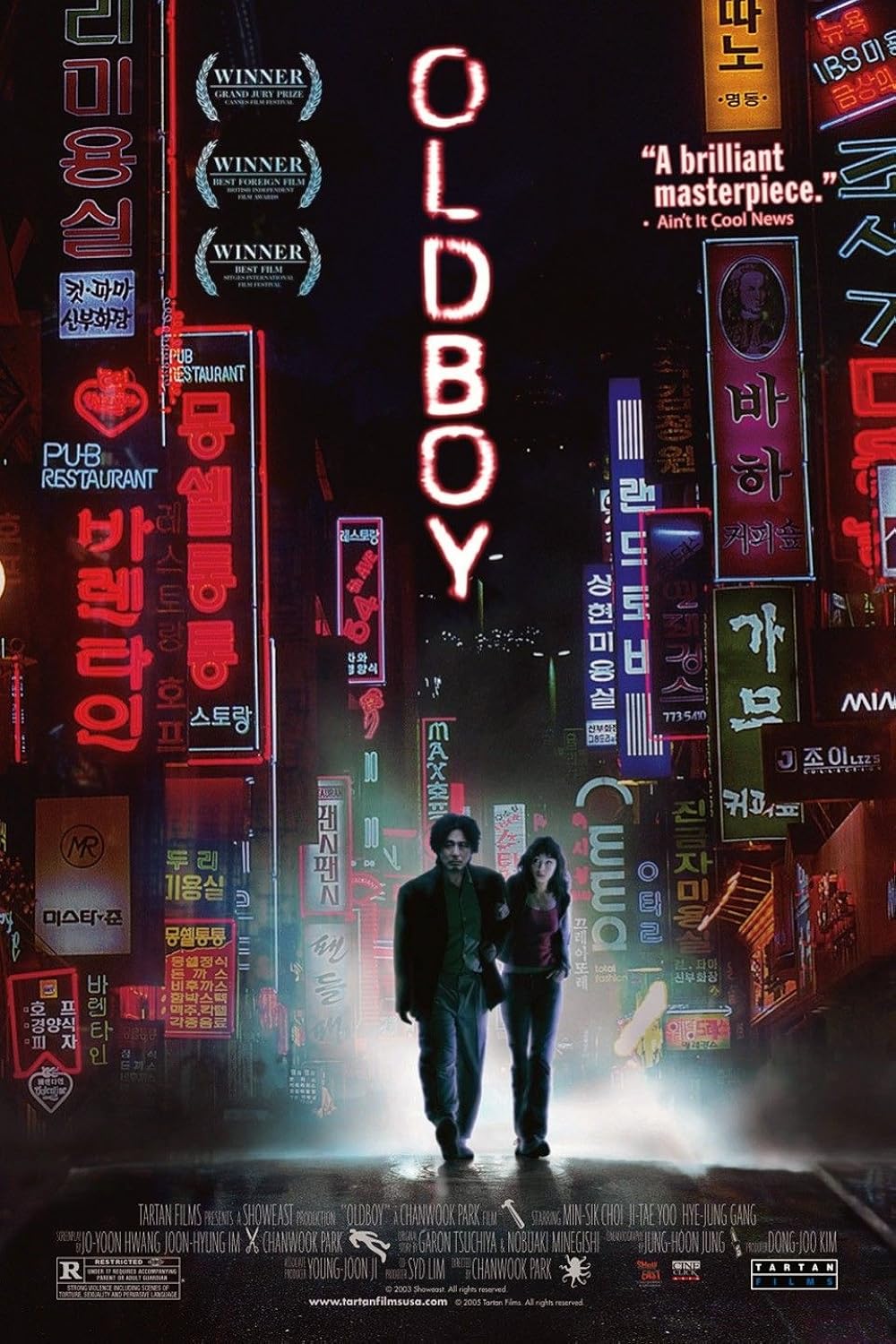
Is this Park Chan-wook’s magnum opus? Loosely based on the manga by Garon Tsuchiya and Nobuaki Minegishi, Oldboy is a similar look at the circular nature of vengeance as Sympathy for Mr. Vengeance, but with a much stronger overall…everything. The writing is crisper, tighter, and deeper. The filmmaking is less concerned with filling time. The acting even goes full operative by the end. And, of course, there’s the hallway fight. A mixture of Greek tragedy, Japanese extremism, and Korean style, Oldboy is really something.
Oh Dae-su (Choi Min-sik), which sounds a whole lot like Odysseus (wink wink), gets taken from a street in the middle of the night and imprisoned in a private prison for fifteen years. He’s released and given just a few days to figure out who ordered his imprisonment and why. The why is important from a plot perspective, giving us the antagonistic pieces, but I want to talk about the overall effort at framing the why.
The why comes from far in Oh Dae-su’s past. So far in the past that he literally forgot about the infraction. It was such a minor thing that had such large repercussions for Lee Woo-jin (Yoo Ji-tae), but Oh Dae-su never…even knew Lee Woo-jin. None of this gets revealed until something like 75% of the way through the film. It should bug me. We have hidden information from the audience only revealed late in the film essentially for shot value, but it would be a misreading of the film’s intent to rest on that. The point of the film isn’t the specifics of Oh’s sin in the past but of how he changes at being faced with it. About how he’s changed not just with facing it but with a precise streak of vengeance meant to put him in a similar place as Lee, to humble him.
Characters often say throughout the film that Oh Dae-su talks too much, so the film being in the style of Greek tragedy needs Oh Dae-su to be humbled specifically around that. It was his idle talking that caused the tragedy that he missed because he moved away from the school, so he must be punished around that specifically. The point isn’t the crime from the past, it’s the punishment of Oh Dae-su for his innate flaw: talking too much. It really is Greek in that way, and I think that’s what gives the ending its power.
But, I skipped over a bunch (a bunch). Oh Dae-su meets a young Japanese chef, Mi-do (Kang Hye-jung), and they fall in love in a twisted way as Oh goes out on his trail of vengeance. He tracks down the private prison because he learned the partial name of the restaurant that provided the prison’s fried dumplings for every meal, and he extracts information (and teeth) and then fights everyone with a hammer (awesome), and Lee reveals himself to Oh, but, again, Oh has no memory of his infraction, and Oh has to dig into his own past with the help of old schoolmate No (Ji Dae-han) until he digs up the memory, pieced together from different sources.
And the face off between Lee and Oh in the end, Oh being a killing machine driven by revenge and Lee having just the right carrot to hang in front of Oh’s face to keep him from swift violence. This creates the character-driven series of motives to keep the plot moving forward. Oh doesn’t kill Lee the first time he can because…Oh is obsessed with the why of he got put away, not just getting revenge for it. That quest for knowledge defines every character choice and drives the plot forward. The entire story is built around the idea of self-discovery in the guise of a revenge plot, and when the self-discovery overwhelms the revenge…it’s palpable.
And Oh’s final speech where he flings himself back and forth emotionally ending with the only way to get him to shut up is brutal and just…perfect. It’s closing the circle the way Euripides would.
This is peak Park Chan-wook. It’s a noticeable step up from everything he’s made so far, the marriage of material and Park’s filmmaking style. That combination of baroque romance, Greek tragedy, and blackly comic situational awareness that creates this tragic but endlessly entertaining package.
Is this Park’s masterpiece? Well, we’re still shockingly early in his filmography, so there’s always time for him to reach new heights. But Oldboy is special.
Rating: 4/4

 David Vining, Author
I honestly can’t say this is Park’s masterpiece, as in singular, but it is A masterpiece.
You really nailed something important when you identified this as a Greek tragedy, body mutilation and all. I think this is one of those magical aspects of Korean cinema, that they absorb storytelling from the West in ways Japan and China resisted and continue to resist to some extent. (one of the reasons Ozu and Kurosawa stand out is that they were willing to embrace some Western storytelling elements in their work. Some. They were not truly Western but they were fans, and Kurosawa comes close)
The Hallway fight is one of the most exciting things in cinema for that entire decade. One continuous take…it makes me giddy to imagine pulling that off and it is exiting from start to finish. But the movie is more than just one sequence, there is guilt and loss galore here. Loss of life, of time, of relationships. There is depth here, not just slasher gore. Though, there’s some of that, with that whole Oedepus Rex vibe.
Choi Min-sik and Kang Hye-jung are so good that I’m gonna go ahead and say Park is one hell of an actor’s director. He’s working with good material (the actors) but he’s really using them well and elevating them…and the source material. I should have known it was based on a Japanese manga as soon as the incest came into the picture….though to be frank, I don’t know if incest fantasy is as common in Korea as it is in Japan. I hope not….
Visually, again, this is just amazing at times.
I’m going to do another watchthrough for my upcoming essay. But for now….wow. What a movie. I can’t recommend it to everyone, but to those who pay attention to their films and can handle the content…it’s one of the top movies of the 21st century, I think. By the way, watching this on the heels of the Fantastic Mister Fox is…really jarring. Both ways.
-Mark
LikeLike
I mostly wonder about “his masterpiece” because Oldboy feels so…different from most of his other work. It’s more active and stuffed than almost anything else he made. The closest stylistic parallel is, I think, I’m a Cyborg but That’s Okay, of all things.
Park made the film what it is, but for a man with a shockingly distinctive style, it almost feels like the work of someone else. Should “his masterpiece” be more in alignment with his style?
But hot damn…it’s such a good entertainment.
I seem to recall you making mention of the film a few months back, saying that you had seen it but had gotten turned off by its ending. Am I misremembering?
LikeLike
No, you’re right. I don’t like the ending. I feel that Dae-sue is the victim here and that he doesn’t ‘need’ to cut his own tongue out, particularly in that he fails to avoid….well there we are in tragedy. The failure to avoid fate or punishment. I don’t think he’s DESERVING though and that almost take it from Drama into Horror….yet its clearly still in Tragedy. So your review is making me recontextualize things I had seen but rejected. Maybe I’m not supposed to like the ending? Maybe I am supposed to accept it. I don’t know. I’ll give it a chance again.
I’m gonna watch again (#3) and make notes. It is a good time at the movies, so it’s no burden, just the time required is the hard part.
-Mark
LikeLike
The way I read it is that Oh Dae-su has such an innate character flaw, talking too much, that the only way he can find anything like happiness in the end is to correct it.
The naming convention of the character recalls either Odysseus or Oedipus, but I also think of other Greek tragic heroes like Ajax. Did Ajax deserve his suicide? Was Oedipus’ decades’ old crime worse than Oh Dae-su’s?
It’s the heart of Greek drama, I think: people being undone by their central flaws.
As William Muney might say, “Deserves got nothin’ to do with it.”
LikeLiked by 1 person